
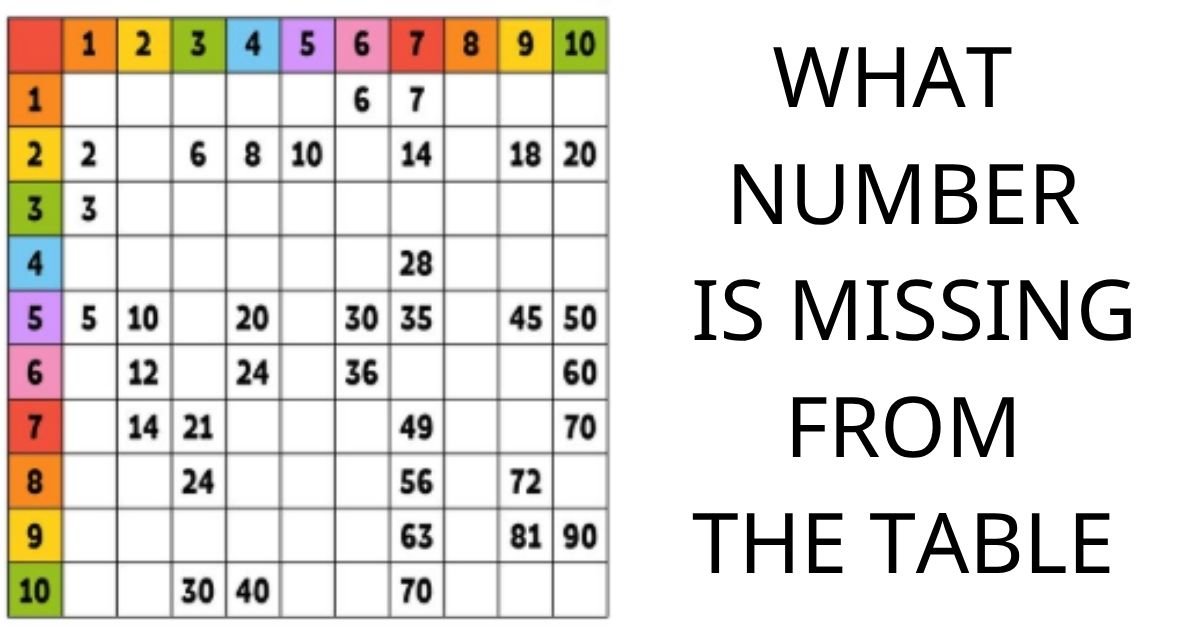
Finding what number is missing from the table is one of the most practical math skills you will use, from grade school worksheets to real-world data analysis. Whether the table uses addition, multiplication, a relative frequency chart, or a pattern-based sequence, there is always a logical rule connecting every cell. Once you know how to spot that rule, the blank almost fills itself in. This article walks you through the most common table types, the step-by-step method for solving each one, and the mistakes that trip people up most often. By the end, you will be able to look at any number table with a missing value and find the answer with confidence.
Quick Answer
To find the missing number in a table, first identify the rule connecting the existing numbers — whether that is addition, multiplication, a consistent pattern across rows or columns, or a formula like relative frequency. Apply that same rule to the row or column containing the blank. Verify your answer by checking it against at least one other row.
How to Find the Missing Number in a Table
The first thing to do when you see a blank in a number table is resist the urge to guess. Most people scan the numbers quickly and pick something that “looks right,” but that approach fails on any table more complex than simple counting. Instead, look at the rows and columns separately before combining your findings.
Take a basic multiplication table where the top row reads 2, 4, 6, 8 and the left column reads 2, 4, 6, 8. Each cell holds the product of the row header and the column header. If the cell at row 6, column 4 is blank, the answer is simply 6 × 4 = 24. The rule here is clear and consistent because every single cell follows it. Real table puzzles work the same way, even when the rule is less obvious at first glance.
For addition tables, the method is identical. Suppose you have a table where the first row sums read 3, 5, 7, 9 and the second row reads 5, 7, 9, 11. Each cell in the table equals the sum of its row number and column number. A blank cell in row 4 and column 6 would be 4 + 6 = 10. Once you confirm the pattern holds across at least two full rows, you can trust it to apply to the missing value as well.
Finding Missing Numbers in Frequency and Data Tables
Statistical tables work differently from arithmetic tables, and they trip up a large number of students at every level. A relative frequency table, for example, lists categories alongside the proportion of total occurrences each one represents. If a teacher records grade results for 25 students and Grade A has a frequency of 6 and a relative frequency of 0.24, you can confirm the total: 6 ÷ 0.24 = 25 students in total.
Now suppose Grade B has a frequency of 7 but the relative frequency cell is blank. You divide 7 by 25 to get 0.28. That is the missing number. The key step most people miss is finding the total first, because without the total, the relative frequency formula has no anchor. The formula is simple: relative frequency equals the category’s individual count divided by the overall total count.
The same logic applies to any proportional or percentage table. If you know that four out of five cells in a row must total 100%, and the existing values sum to 72%, the missing value is 28%. Always check whether the rule is additive (rows or columns sum to a fixed number) or multiplicative (cells equal a product of headers) before calculating, since applying the wrong formula gives the wrong answer every time.
Pattern-Based Tables: Reading Rows and Columns Together
Some tables do not use standard arithmetic operations at all. Instead, each cell’s value comes from combining the row value and the column value through a less obvious rule. These appear frequently in math puzzles, brain teasers, and competitive exams. The approach is to look at a cell where you know all three values — the row header, the column header, and the cell itself — and work out the relationship.
Imagine a table where row 3 and column 4 give the cell value 12, row 5 and column 4 give 20, and row 2 and column 6 gives 12. Here the rule is: row header × column header = cell value. Finding a blank in row 7 and column 3 gives 21. You can use the percentage calculator at Numberble to quickly verify proportional relationships when your table involves percentages or ratios, saving time on the mental arithmetic.
More complex patterns involve differences between consecutive cells. In a puzzle where the values down a column read 3, 11, 12 and the rule is that each cell equals the sum of the two values above it, minus 2, you can work through the steps systematically. Recognizing this kind of second-order rule takes practice, but the method is always the same: find three complete data points, deduce the rule, then apply it once more to find the blank.
Step-by-Step Method for Any Missing Number Table
Solving any missing-number table becomes manageable with a clear sequence of steps. Start by looking for the row or column that is most complete, meaning the one with the fewest unknowns. Identify the operation or rule that connects all the known values in that row or column. Confirm your suspected rule against a second complete row or column. Then apply the rule to the incomplete row or column to find the missing value, and finally check the result against whichever row or column intersects the blank cell from a different direction.
For instance, if you work out the missing value by analyzing the column and it gives you 42, check whether 42 also fits the row pattern. If both directions agree, you have the right answer. If they disagree, one of your two assumed rules is wrong and you need to reassess. This cross-checking step is what separates confident solvers from those who second-guess themselves after finishing.
According to Khan Academy’s math curriculum, pattern recognition in tables is a foundational skill that connects directly to algebra, since tables are essentially function mappings between input and output values. Every row in a function table is a paired input-output relationship, and recognizing that connection makes the logic behind table puzzles far easier to understand.
What Most People Get Wrong About Missing Number Tables
The most common mistake is assuming that all tables follow a row-based pattern when many actually follow a column-based one, or a combined rule that uses both directions. A student who sees the numbers 2, 4, 8, 16 in a row will often assume the rule is “multiply by 2 going right” and apply it to find a blank in the next row. But if that next row reads 3, 9, 27, the rule there is “multiply by 3 going right,” not “multiply by 2.” Each row can have its own rule, and assuming a single rule covers the entire table is where most wrong answers come from.
The confusion happens because early practice tables in school almost always use a single consistent rule across the entire grid, such as multiplication tables or addition tables. When students encounter tables where rows and columns each have their own independent pattern, they apply the familiar single-rule thinking and land on the wrong number. The correct approach is to treat each row and each column as its own mini-sequence and identify the rule within it separately. Only then should you use both directions together to verify the answer.
Types of Tables Where Missing Numbers Appear
Missing number problems appear in many different table formats, and recognizing the type immediately points you toward the right solving method. Arithmetic tables, which include addition and multiplication grids, follow fixed row-and-column header rules. Frequency tables, as covered earlier, rely on counts and totals. Function tables map inputs to outputs through a single rule applied consistently. Puzzle or brain-teaser tables use hidden combined rules that require discovery rather than application of known formulas.
Exam questions, particularly on standardized tests, tend to favor function tables and frequency tables because they test whether students understand what a table represents rather than just whether they can compute numbers. Knowing the difference between these types is practical because it changes how you start the problem. Jumping straight to arithmetic without asking “what kind of table is this?” leads to wasted effort, especially under timed conditions.
FAQ
What is the fastest way to find a missing number in a table?
Identify the operation connecting the known values in the same row or column as the blank, then apply it once. Cross-check your answer against the intersecting row or column to confirm it.
Can a table have more than one correct missing number?
Only if the pattern is genuinely ambiguous, which is rare in well-constructed problems. Most tables have a single consistent rule that points to exactly one correct answer.
How do I find a missing number in a relative frequency table?
First calculate the total count using a category where both frequency and relative frequency are known. Then divide the blank category’s frequency by that total to get the missing relative frequency.
What do I do when no obvious pattern exists?
Try differences between consecutive values, then ratios, then combined row-and-column products. If none of those work, look for a rule involving diagonals or cross-referencing cells from different rows and columns.
Are missing number table questions common on standardized tests?
Yes, they appear regularly on middle and high school math assessments, SAT prep, and competitive exams. They typically test pattern recognition, proportional reasoning, and function mapping rather than pure calculation.
Conclusion
The secret to finding what number is missing from the table is always the same: identify the rule before touching the blank. Once you know whether you are dealing with an arithmetic table, a frequency table, or a pattern-based puzzle, the path to the answer becomes straightforward. Your next step is to practice on a few different table types since arithmetic, function-based, and statistical tables each train a slightly different part of the same skill. The more table types you work through, the faster pattern recognition becomes, and eventually the rule jumps out before you even think to look for it.