
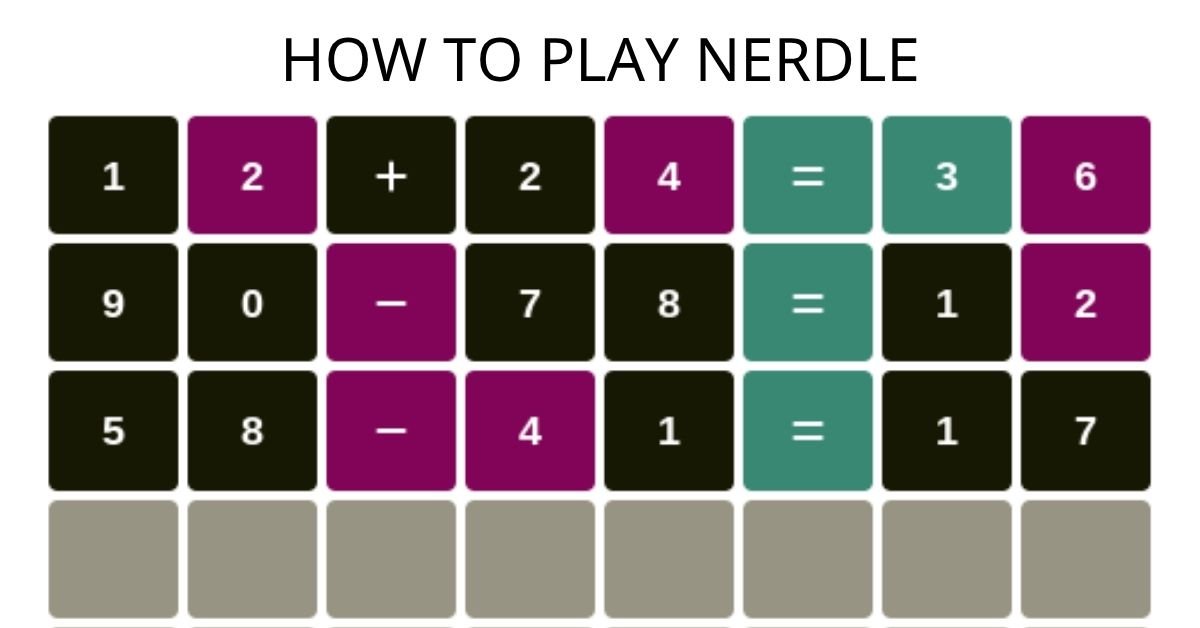
Nerdle is a daily math puzzle that challenges you to find a hidden equation in six tries, using color-coded feedback after every guess. This guide covers everything you need to know about how to play Nerdle, from the basic rules to the strategies that separate beginners from consistent solvers. Whether you fired it up for the first time today or you’ve been playing for a week and feel stuck, this article will give you a clear picture of the mechanics, the logic behind smart guessing, and the specific mistakes that trip up most new players.
Quick Answer
Nerdle is a free daily math puzzle where you guess an 8-character equation in 6 tries. Each guess must be a valid math equation. After each attempt, tiles turn green (right position), purple (wrong position), or black (not in the equation). Use those color clues to narrow down the answer.
What Is Nerdle and Where Did It Come From
Nerdle is a free, browser-based math puzzle created by Richard Mann and his daughter Imogen in early 2022. The idea came out of a car ride conversation about the Wordle craze, when they realized there was no equivalent for math fans. Within minutes they had settled on the rules and the name, and the game quickly spread to players in over 53 countries within its first week. The original version presents you with an 8-character equation, using digits 0 through 9 and the operators plus, minus, multiply, divide, and equals. There are currently 17,723 chosen solutions, selected from over 100,000 mathematically valid possibilities by the Nerdle team.
The game resets daily at midnight GMT, meaning everyone around the world solves the same puzzle on the same day. A new challenge appears at 4 PM PST, 7 PM EST, or 1 AM Central European Time, depending on your location. You can also switch on a local time reset in the settings so the puzzle refreshes at midnight in your own time zone instead.
The Core Rules Explained
Every guess you enter must be a mathematically correct equation. That means the left side must actually equal the number on the right side of the equals sign, otherwise you’ll see a message that says “That guess doesn’t compute” and it won’t count as a try. The equals sign must always be present, and there can only be a plain number on the right side of it, never another calculation.
Standard order of operations applies throughout the game. Multiplication and division are calculated before addition and subtraction, so an equation like 1+2*4=9 is valid because you multiply 2 by 4 first to get 8, then add 1. Many players find this catches them off guard, especially if they haven’t thought about PEMDAS or BODMAS since school. The good news is that the game provides a clear error message if your math is wrong, so you never accidentally waste a guess on an equation that doesn’t work.
Commutative answers are accepted by default. If the target equation is 10+20=30 and you type 20+10=30, the game recognizes them as equivalent and accepts it as correct. This rule only applies when every other part of your equation matches the solution exactly. You can switch off commutative acceptance in the settings if you want the stricter version of the challenge.
A Step-by-Step Beginner’s Guide to Playing Nerdle
Open your browser and go to nerdlegame.com. You’ll see a grid of 6 rows and 8 columns, along with an on-screen keyboard showing digits and operators. If you’re on a laptop, you can also type using your physical keyboard, which most experienced players prefer for speed.
Your first guess should be a valid equation that uses as many different digits and operators as possible. A strong opening guess like 12+35=47 immediately reveals information about six different digits. After you hit enter, each tile flips to show a color: green means the character is correct and in the right position, purple means it exists in the equation but sits in the wrong spot, and black means it doesn’t appear in the solution at all.
Use those colors to build your second guess. If a tile turned green, keep that character in the exact same position. If it turned purple, you know the character is needed somewhere else in the equation, so move it to a different spot while keeping the equation valid. Black tiles tell you to stop using that character entirely. By the third and fourth guess, you should be significantly narrowing down the possibilities. Most players who use clues systematically can crack the puzzle in four tries or fewer.
Nerdle Game Variants Worth Knowing
The classic 8-tile version is the flagship puzzle, but Nerdle also offers several variants for different moods and skill levels. Mini Nerdle uses only 6 characters, which makes it shorter and slightly more accessible while still requiring real logical thinking. Speed Nerdle starts you with a partial guess and counts down a clock, adding pressure to your decision-making in a way that feels entirely different from the relaxed daily puzzle.
Instant Nerdle is the hardest variant in many ways: you’re given all the digits and have exactly one guess to arrange them into the correct equation. There’s no forgiveness and no second chance. Pro Nerdle lets you create your own challenge and share it with a custom link, which makes it a great option for teachers, puzzle groups, or anyone who wants to challenge a friend with a specific calculation.
If you enjoy number-based puzzles beyond equation guessing, the Numberle game on Numberble.com offers a similar challenge focused on pure number sequences, and it’s worth a look after you’ve built your Nerdle instincts.
Strategy for Players Who Want to Improve
The most important principle in Nerdle is information efficiency. Your first two guesses should collectively reveal as much as possible about which digits and operators are in play. Mathematically analyzed starting pairs like 12+35=47 and 80/16=05 together cover almost all the digits and both common operators across just two tries.
Pay attention to operator position, not just digit position. Getting an operator confirmed as green or purple cuts down possibilities faster than confirming individual digits, because there are only four operators but ten possible digits. Once you know whether the solution uses multiplication or division, your remaining guesses become dramatically more targeted.
Think about the structure of valid equations before typing anything. If you know the equals sign is in the sixth position, the solution is likely a two-digit result. If it’s in the seventh position, the result is probably a single digit. Tracking the position of the equals sign after your first guess tells you a great deal about the shape of the equation you’re looking for.
What Most People Get Wrong About Nerdle
The most common misconception new players have is that any equation that looks valid will be accepted. In reality, Nerdle enforces strict rules about leading zeros and negative numbers. Equations like 01+2=03 won’t appear as solutions because Nerdle answers never start with a zero. Similarly, negative starting numbers and negative results on the right side of the equals sign are excluded from the solution pool, even if mathematically valid as guesses.
This confusion causes players to waste guesses on equation structures that could never be answers. Someone might spend a guess testing -5+15=10 thinking they’re being clever, but the game would never use that as a solution. Knowing that all Nerdle solutions use positive starting numbers, no leading zeros, and only non-negative results on the right of the equals sign lets you filter a large portion of equation types right from the start.
Using the Color System Like an Expert
The doubles rule is the most misunderstood part of the color feedback system. If the solution contains one instance of the digit 3 but your guess contains two 3s, you’ll receive one colored tile and one black tile for those two characters. The game marks correct-position characters green first, then colors the remaining instances based on whether extras are needed. Getting one black on a repeated character tells you the solution uses that character fewer times than you guessed, not that it’s absent entirely.
For detailed guidance on how order of operations affects puzzle-solving, the official Nerdle blog on order of operations walks through PEMDAS, BODMAS, and BIDMAS with clear worked examples, and it’s particularly useful if your school math is a bit rusty.
FAQ
Can I play Nerdle without creating an account?
Yes, Nerdle is completely free to play without any sign-up. Creating an account is optional but lets you save your stats, maintain your streak across devices, and earn badges for consistent play.
Why does my valid equation keep saying “that guess doesn’t compute”?
Double-check your order of operations. Nerdle calculates multiplication and division before addition and subtraction, so 3+2*4 equals 11, not 20. The left side of your equation must produce exactly the number shown on the right side of the equals sign.
Is the Nerdle puzzle the same for everyone each day?
Yes, every player worldwide sees the same puzzle on the same day. That shared experience is a big part of what makes comparing results with friend’s fun.
How do I play older Nerdle puzzles I missed?
You can replay any past puzzle by adding a date to the end of the URL in the format nerdlegame.com/YYYYMMDD. For example, nerdlegame.com/20240315 takes you directly to the puzzle from March 15, 2024.
What’s the difference between a streak and a straight in Nerdle?
A streak counts consecutive wins, while straight counts consecutive days played, whether or not you won. Badges in Nerdle are earned through straights, not streaks, so simply playing every day keeps your straight alive even on hard puzzle days.
Conclusion
Nerdle rewards players who think in equations rather than just numbers. The fastest path to consistent improvement is treating your first two guesses as information-gathering tools rather than attempts to guess the answer outright. Start with equations that cover a wide spread of digits and operators, use the color clues methodically, and keep in mind that solutions never start with zero or a negative number. Give it a few days of daily play and the logic starts to click into a satisfying rhythm.