
How to Play Nerdle: Rules, Tips & Strategy
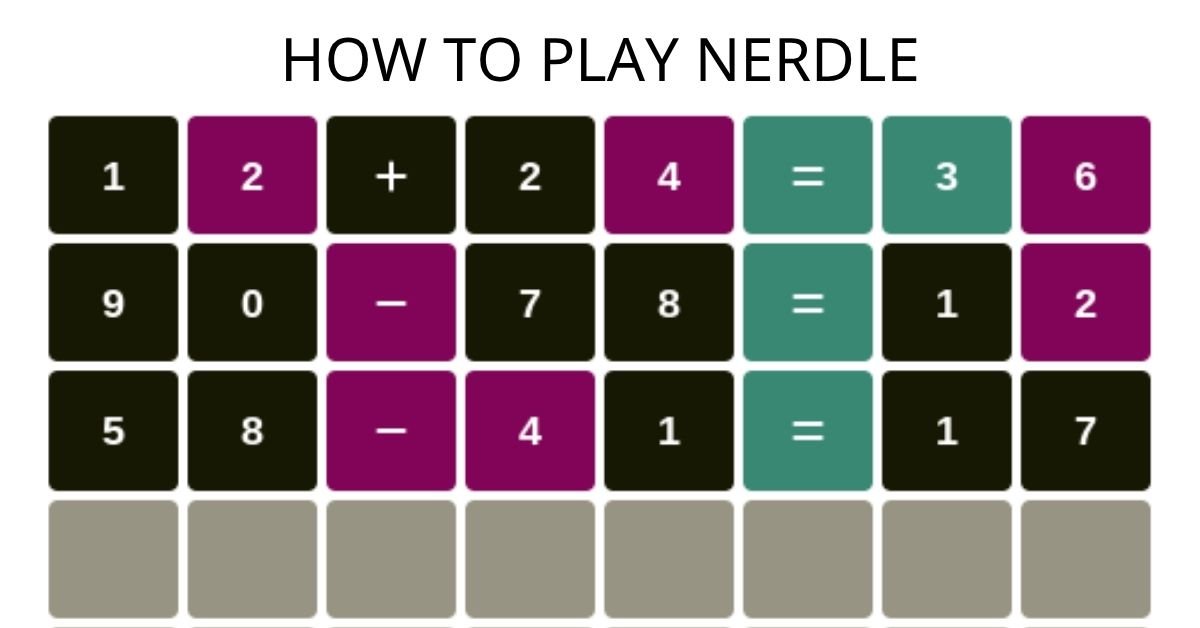
Nerdle is a daily math puzzle that challenges you to find a hidden equation in six tries, using color-coded feedback after every guess. This guide covers everything you need to know about how to play Nerdle, from the basic rules to the strategies that separate beginners from consistent solvers. Whether you fired it up for the first time today or you’ve been playing for a week and feel stuck, this article will give you a clear picture of the mechanics, the logic behind smart guessing, and the specific mistakes that trip up most new players. Quick Answer Nerdle is a free daily math puzzle where you guess an 8-character equation in 6 tries. Each guess must be a valid math equation. After each attempt, tiles turn green (right position), purple (wrong position), or black (not in the equation). Use those color clues to narrow down the answer. What Is Nerdle and Where Did It Come From Nerdle is a free, browser-based math puzzle created by Richard Mann and his daughter Imogen in early 2022. The idea came out of a car ride conversation about the Wordle craze, when they realized there was no equivalent for math fans. Within minutes they had settled on the rules and the name, and the game quickly spread to players in over 53 countries within its first week. The original version presents you with an 8-character equation, using digits 0 through 9 and the operators plus, minus, multiply, divide, and equals. There are currently 17,723 chosen solutions, selected from over 100,000 mathematically valid possibilities by the Nerdle team. The game resets daily at midnight GMT, meaning everyone around the world solves the same puzzle on the same day. A new challenge appears at 4 PM PST, 7 PM EST, or 1 AM Central European Time, depending on your location. You can also switch on a local time reset in the settings so the puzzle refreshes at midnight in your own time zone instead. The Core Rules Explained Every guess you enter must be a mathematically correct equation. That means the left side must actually equal the number on the right side of the equals sign, otherwise you’ll see a message that says “That guess doesn’t compute” and it won’t count as a try. The equals sign must always be present, and there can only be a plain number on the right side of it, never another calculation. Standard order of operations applies throughout the game. Multiplication and division are calculated before addition and subtraction, so an equation like 1+2*4=9 is valid because you multiply 2 by 4 first to get 8, then add 1. Many players find this catches them off guard, especially if they haven’t thought about PEMDAS or BODMAS since school. The good news is that the game provides a clear error message if your math is wrong, so you never accidentally waste a guess on an equation that doesn’t work. Commutative answers are accepted by default. If the target equation is 10+20=30 and you type 20+10=30, the game recognizes them as equivalent and accepts it as correct. This rule only applies when every other part of your equation matches the solution exactly. You can switch off commutative acceptance in the settings if you want the stricter version of the challenge. A Step-by-Step Beginner’s Guide to Playing Nerdle Open your browser and go to nerdlegame.com. You’ll see a grid of 6 rows and 8 columns, along with an on-screen keyboard showing digits and operators. If you’re on a laptop, you can also type using your physical keyboard, which most experienced players prefer for speed. Your first guess should be a valid equation that uses as many different digits and operators as possible. A strong opening guess like 12+35=47 immediately reveals information about six different digits. After you hit enter, each tile flips to show a color: green means the character is correct and in the right position, purple means it exists in the equation but sits in the wrong spot, and black means it doesn’t appear in the solution at all. Use those colors to build your second guess. If a tile turned green, keep that character in the exact same position. If it turned purple, you know the character is needed somewhere else in the equation, so move it to a different spot while keeping the equation valid. Black tiles tell you to stop using that character entirely. By the third and fourth guess, you should be significantly narrowing down the possibilities. Most players who use clues systematically can crack the puzzle in four tries or fewer. Nerdle Game Variants Worth Knowing The classic 8-tile version is the flagship puzzle, but Nerdle also offers several variants for different moods and skill levels. Mini Nerdle uses only 6 characters, which makes it shorter and slightly more accessible while still requiring real logical thinking. Speed Nerdle starts you with a partial guess and counts down a clock, adding pressure to your decision-making in a way that feels entirely different from the relaxed daily puzzle. Instant Nerdle is the hardest variant in many ways: you’re given all the digits and have exactly one guess to arrange them into the correct equation. There’s no forgiveness and no second chance. Pro Nerdle lets you create your own challenge and share it with a custom link, which makes it a great option for teachers, puzzle groups, or anyone who wants to challenge a friend with a specific calculation. If you enjoy number-based puzzles beyond equation guessing, the Numberle game on Numberble.com offers a similar challenge focused on pure number sequences, and it’s worth a look after you’ve built your Nerdle instincts. Strategy for Players Who Want to Improve The most important principle in Nerdle is information efficiency. Your first two guesses should collectively reveal as much as possible about which digits and operators are in play. Mathematically analyzed starting pairs like 12+35=47 and 80/16=05 together cover almost all the digits and both common operators across just two … Read more